AI Agents vs Generative AI: What Auditors Need to Know in 2026
Diving into AI can feel daunting, especially when your team has been using familiar workflows for a long time. New terminology, new capabilities, and rising expectations can make it tough to know where to begin. The good news is that things become much clearer once you understand the two types of AI shaping today’s audit and finance work: AI agents and generative AI.
This article breaks down both and explains how each one supports everyday audit tasks. Once you see what they’re designed to do, it becomes much easier to spot where AI can make your workflow faster, clearer, and far less manual.
What is generative AI?
Generative AI is designed to produce answers such as explanations, summaries, classifications, or structured information based on the documents and prompts you provide. Instead of performing a sequence of actions, it focuses on interpreting documents and presenting clear, usable responses.
Why this matters in audit
For auditors, this matters because so much of the job involves navigating unstructured, text-heavy evidence. Generative AI helps teams work through these documents faster by:
- Pulling specific answers from long or messy PDFs
- Summarizing complex or wordy documentation
- Highlighting the most relevant information
- Classifying content without manual sorting
In short, generative AI accelerates the “read, understand, and extract” phase of an engagement and reduces the hours typically spent reviewing contracts, invoices, statements, agreements, program guidelines, and other supporting documents.
How DataSnipper uses generative AI
- UpLink analyzes client submissions, checks whether uploaded documents meet your criteria, and surfaces what requires attention.
- DocuMine pinpoints the information you need inside your documents, presents it clearly, and shows exactly where each finding came from to keep every conclusion traceable and easy to validate.
What are AI agents?
AI agents refer to AI systems that can take action toward a goal based on the prompts provided by the user. Instead of focusing on generating an answer, they are built to execute steps, interact with tools, and make context-aware decisions within a defined framework. This gives them enough autonomy to adapt to different situations while still following the user’s intent.
Why this matters in audit
For auditors, AI agents are relevant because many procedures require structured actions, decision points, and documentation. AI agents can support this work by:
- Running checklists and following rule-based criteria
- Evaluating disclosures against established requirements
- Performing tie-outs and reconciliations
- Applying logic consistently across files
- Moving through multi-step testing processes inside familiar tools
In short, AI agents help with the “perform and document” phase of an engagement, especially when tasks require accuracy, consistency, contextual decision-making, and clear traceability across multiple steps.
How DataSnipper uses AI agents
- Disclosure Agents transform manual disclosure checklist reviews into guided, smarter workflows, providing a clear audit trail of the actions performed while keeping auditors in the loop.
Want the deeper dive on AI agents and disclosures? Check out our on-demand webinar.
- Excel Agents carry out sequences of audit steps inside Excel, including matching, checking, validating, and documenting, all without manual clicking.
Want early access to Excel Agents and a chance to shape how it evolves? Join our Design Partner Program.
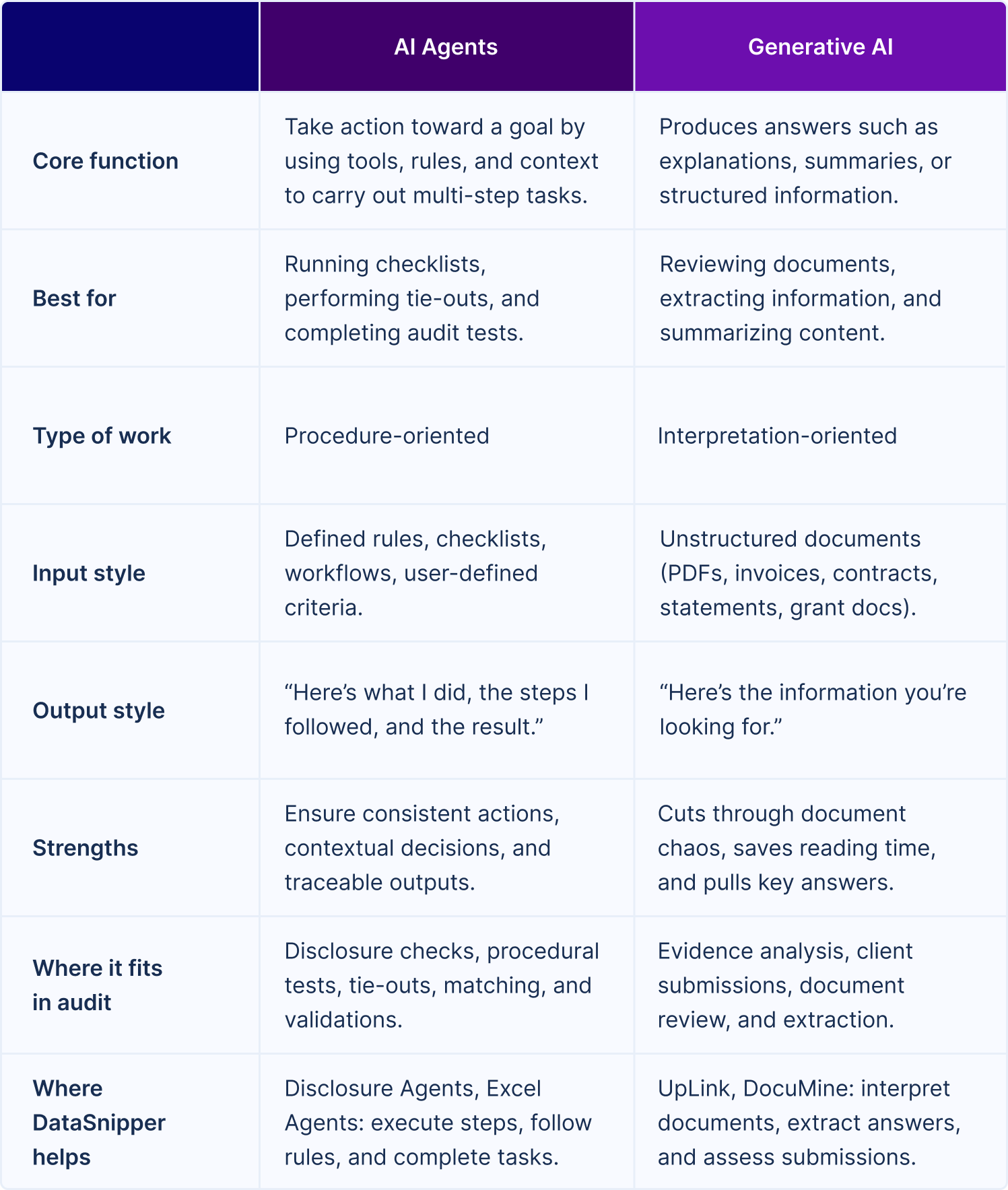
AI Agents vs Generative AI: Practical differences for audit teams
The table below summarizes the key differences between AI agents and generative AI covered earlier, giving you a quick side-by-side view of how each supports audit work.
Your next step in modernizing audit
AI Agents and generative AI each bring unique strengths to the audit workflow. One helps you understand and interpret complex documents, while the other carries out actions, applies rules, and completes parts of the process on your behalf. Together, they help audit teams work faster, document more clearly, and stay focused on the judgments that matter most.
As firms modernize their approach, adopting the right mix of these technologies can significantly improve efficiency, clarity, and consistency across engagements.

.svg?width=600&quality=70&format=auto&crop=16%3A9)